
From Shrub to Tree
What spiritual maturity actually looks like

Most Christians want maturity.
Few understand how it usually grows.
We often imagine discipleship like a light switch. One moment immature, the next moment spiritually strong, stable, fruitful, and wise. But Scripture consistently describes growth differently. It describes life that develops organically. Often slowly. usually through patience. Always through seasons.
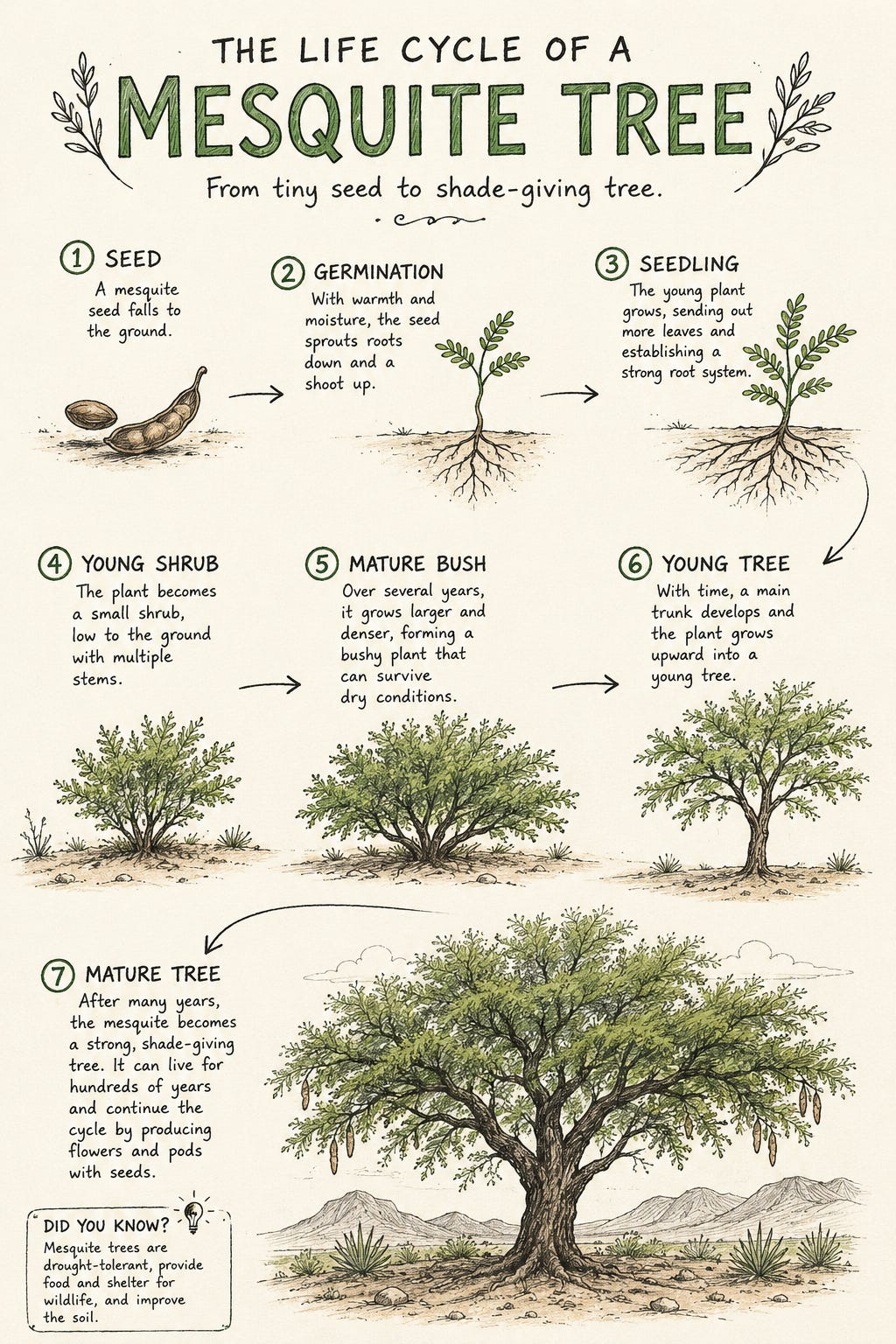
I live in Southeast Arizona, and one particularly difficult plant/tree is the mesquite. As I was looking at the lifecycle of this mesquite. I was reflecting on how it looks unimpressive at first. It begins small and scrub-like, more like a little weed. For years it may resemble little more than a stubborn bush surviving in hard rocky soil. Yet over time, with deepening roots, it becomes a strong tree capable of weathering heat, drought, and storms while providing shade and nourishment to others. I have several of these trees near my house, they have survived drought, desert heat, wildfires and ornery sheep.
The image of a tree is often a biblical metaphor for spiritual life and growth.
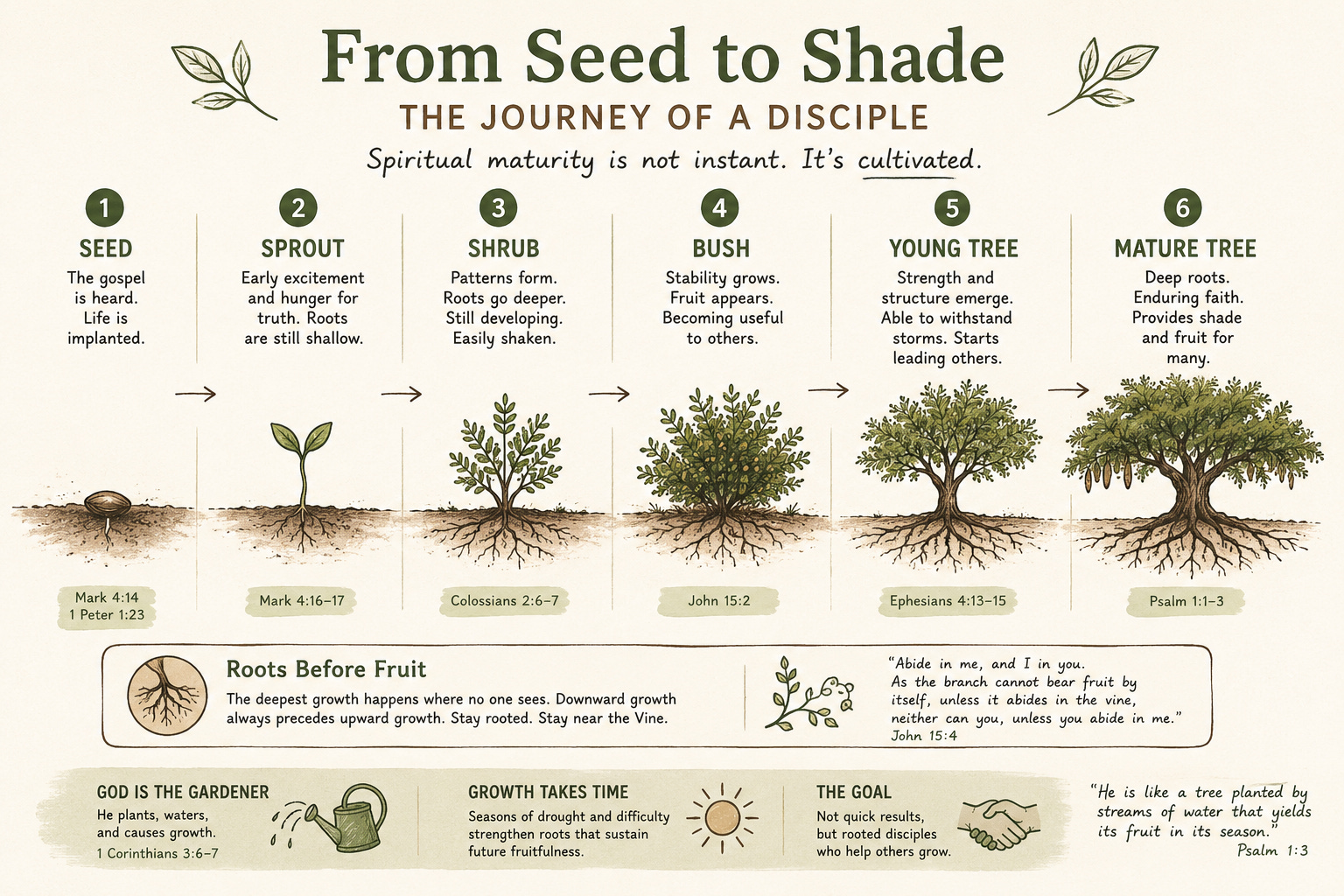
Scripture repeatedly describes the righteous as trees, seeds, vines, branches, and planted things. Spiritual maturity is not mechanical production. It is cultivated life. I want to walk through this lifescycle with you as a reflection on Christian discipleship and growth.
The Seed
Every disciple starts here, with the gospel is heard, and God grants life through His Word by His Spirit.
Jesus said, “The sower sows the word” (Mark 4:14).
Peter writes, “You have been born again, not of perishable seed but of imperishable, through the living and abiding word of God” (1 Peter 1:23).
No growth happens apart from life. This is the foundational truth that modern discipleship models can miss. Christianity does not begin with external behavior modification. It does not begin with techniques, systems, or measurable outcomes. It begins with a sovereign act of God by which the dead are made alive (Eph 2:1–5; John 3:3–8).
The seed is hidden. The work of regeneration is invisible to us. We do not see God plant. We see only what comes up afterward. That is why we cannot measure conversion by initial enthusiasm or external response. We measure it by what eventually grows.
We must be born again. Without that, every other stage is impossible.
The Sprout
Early growth is often visible and exciting.
There is zeal and hunger for truth, you can often see rapid change, even visible enthusiasm abounds. The new believer can seem to get enough of Scripture. He prays with tears. She tells everyone what God has done.
But roots are still shallow, various strange doctrines can come in and upset and even disrupt peace. There is no strong immune system to protect from false teaching.
Jesus warned that some receive the word “with joy,” yet quickly fall away because they “have no root in themselves” (Mark 4:16–17). The sprout looks identical to the seedling that will become a tree. Time and trial alone reveal the difference.
This is why early discipleship matters so much. New believers need more than emotionalism. They need grounding in the gospel and in the ordinary means of grace. Scripture. Prayer. The Lord’s Supper. Membership in a faithful local church. Sound doctrine taught patiently. Correction received humbly. Encouragement that aims at endurance rather than excitement.
Peter exhorts new believers, “Like newborn infants, long for the pure spiritual milk, that by it you may grow up into salvation” (1 Peter 2:2). Growth is normal. Growth is expected. But growth requires the right food.
Sprouts are alive. They are also fragile. The faithful pastor and the faithful family treat them accordingly.
The Shrub Stage
This may be the most overlooked stage of discipleship.
The believer is genuinely growing, but still inconsistent. There are real signs of life, and there is also real immaturity. Patterns of obedience are forming, though not yet deeply rooted. Often the patterns built here either become what must be repented of later, or they become the steady habits of a lifetime.
This stage is where many Christians become discouraged. Growth feels slow. Sin remains. Old patterns reassert themselves. The believer wonders whether anything has actually changed.
But shrubs are not failed trees. They are growing into what they were made to be. The mature shape is already present in seed form, even if the silhouette has not yet emerged. A mesquite at this stage looks scraggly. Bent. Thorny. The casual eye sees nothing remarkable. But the roots are doing their work. You can weedwack a mesquite and it will all but disappear, though it is still alive.
Roots develop beneath the surface long before towering strength appears above ground. Paul writes, “Therefore, as you received Christ Jesus the Lord, so walk in him, rooted and built up in him and established in the faith” (Col 2:6–7).
Notice the order. Rooted before built up. Much of God’s work in discipleship happens invisibly. The believer who is faithfully attending to Scripture, prayer, and the means of grace is being rooted, even when he cannot feel it.
The pastoral temptation here is to look for visible fruit too quickly, it can be easy to write someone off. The biblical wisdom is to keep watering and trust the God who gives the growth (1 Cor 3:6–7).
The Bush Stage
At this point, stability begins to emerge.
The disciple becomes dependable. Less prone to doctrinal sickness. Less easily moved by the latest controversy. Fruit appears more consistently. Trials no longer completely uproot him. His life begins to provide encouragement to others.
This is often where Christians begin serving meaningfully within the local church. Teaching a children’s class. Hosting a small group. Helping a younger believer through a hard season. Quiet, ordinary acts of service that build up the body.
Not perfect. Not yet mature. But increasingly useful. Also significantly more robust, to take a mesquite down requires a saw and a shovel.
Jesus describes this kind of fruitfulness in John 15. Healthy branches bear fruit because they remain connected to the vine. The disciple’s growing dependence on Christ begins to define him. He is learning that apart from Christ he can do nothing, and that in Christ even small acts of obedience bear real fruit.
Galatians 5 says that the fruit is Love, joy, peace, patience, kindness, goodness, faithfulness, gentleness, self-control. These are not produced by effort alone. They are produced by the Spirit in those who walk by the Spirit (Gal 5:16, 22–25). They show up not in dramatic moments but in the texture of ordinary life. In how a man speaks to his wife at the end of a hard day. In how a woman receives correction from a sister. In how a young man receives admonishment from an elder.
The bush stage is unspectacular. It is also indispensable. Most of the church’s labor is carried by saints in this stage.
The Young Tree
Now the structure becomes obvious.
Deep convictions. Doctrinal stability. Endurance through suffering. The ability to help others mature. Paul writes, “So that we may no longer be children, tossed to and fro by the waves and carried about by every wind of doctrine, by human cunning, by craftiness in deceitful schemes” (Eph 4:14).
A mature disciple is not merely informed. He is stable and reliable. He has seen the cost of false teaching and the beauty of the truth. He has been disappointed by men and refined by trial. He knows his own heart well enough to be patient with the hearts of others.
Hebrews speaks of those “who have their powers of discernment trained by constant practice to distinguish good from evil” (Heb 5:14). Discernment is trained, not downloaded. It comes through years of wrestling with Scripture, sitting under faithful preaching, walking through suffering, and learning to read the difference between godly grief and worldly grief, between conviction and condemnation, between sound doctrine and plausible error.
Many modern approaches to discipleship prioritize excitement, novelty, or emotional intensity. Biblical maturity looks more like rootedness than constant movement. Faithfulness in small things. The slow accumulation of decades of obedience in the same direction.
This is also the stage where the disciple begins to disciple others in earnest. Paul tells Timothy, “What you have heard from me in the presence of many witnesses entrust to faithful men who will be able to teach others also” (2 Tim 2:2). The young tree is no longer only being shaped. He is beginning to shape.
The Mature Tree
A mature tree provides shade. that others rest beneath. Its roots run deep enough to survive drought seasons that would have killed it years earlier. Its fruit nourishes others. Its stability blesses the surrounding environment.
Psalm 1 captures it: “He is like a tree planted by streams of water that yields its fruit in its season, and its leaf does not wither. In all that he does, he prospers” (Ps 1:3).
Psalm 92 extends the picture into old age: “The righteous flourish like the palm tree and grow like a cedar in Lebanon. They are planted in the house of the Lord; they flourish in the courts of our God. They still bear fruit in old age; they are ever full of sap and green” (Ps 92:12–14).
The mature tree does not strain to appear alive. It is alive, there is no mistaking its form at this point. And because it is rooted, fruit comes in season.
This is the Titus 2 vision. Older men teaching younger men sound doctrine and self-control. Older women teaching younger women to love their husbands and children. The kind of saint whose presence provides steadfastness. Whose counsel is sought because it has been tested. Whose prayers carry weight because they have been offered for decades. A long highway of faithfulness has been traveled.
This kind of maturity cannot be microwaved. It grows through years of ordinary faithfulness, suffering, repentance, prayer, Scripture meditation, and perseverance within the life of the church. It is forged in the daily habits no one sees.
The Hidden Reality
What fascinates me most about the mesquite is that much of its survival depends on what cannot be seen.
Its roots.
Before significant upward growth occurs, deep downward growth must happen first. The mesquite spends its early years sending its taproot down through caliche and rock to find water that no shallow rooted plant can reach. When the drought comes, and it always comes in the desert, the mesquite survives.
The same is true spiritually. A shallow rooted disciple may appear impressive for a season. But suffering, temptation, doctrinal confusion, or hardship eventually reveal the depth of the root system.
Jeremiah saw this clearly:
“Blessed is the man who trusts in the Lord, whose trust is the Lord. He is like a tree planted by water, that sends out its roots by the stream, and does not fear when heat comes, for its leaves remain green, and is not anxious in the year of drought, for it does not cease to bear fruit.” Jeremiah 17:7–8
Notice what is not promised. The blessed man is not promised a life without heat or drought. He is promised that when they come, he will not fear. His leaves will not wither. He will continue to bear fruit. Not because of his strength, but because his roots reach the stream.
Discipleship cannot aim only at external conformity or emotional experience. It must aim deeper:
deep roots in Scripture
deep roots in Christ
deep roots in the local church
deep roots formed through suffering and obedience
These are formed by the ordinary means of grace, applied over years—decades even, in the soil of a faithful local church.
Healthy Churches Understand This
Healthy churches do not despise believers in the shrub stage.
They cultivate patiently.
Parents understand this instinctively with children. Farmers understand it with crops. Churches are often tempted to expect instant maturity. Pastors are often tempted to measure success by attendance, decisions, or program output rather than by the slow, quiet formation of saints.
But God grows trees over years.
And often in deserts, the harshest environments.
The desert is not an accident. The mesquite would not be the mesquite without the heat. Its deep root system is forced by the dry years, with the scorching heat, and the brutal winds. So with the saint. The hard providence, the long affliction, the season of unanswered prayer. These are the conditions God uses to send roots downward.
The goal is not flashy Christians produced quickly. The goal is rooted disciples who endure, bear fruit, and help others grow. Churches that aim at the first goal often produce sprouts that wither. Churches that aim at the second produce trees, slowly, over decades.
That kind of maturity takes time. Suffering is not a bug in the Christian life, it is a feature.
But when God grows a tree, the shade becomes a blessing to many. Children play under it. The weary rest under it. Younger saints learn beneath its branches. And when the tree finally falls, its seed is already in the ground.
May God make our churches into orchards. May He give us the patience to water shrubs. And may He grant that, in His time, the desert blossoms with trees planted by His own hand.
Very helpful. Answered some questions about maturity that I had and provided some needed encouragement where I was starting to feel defeated.