You Already Have Everything. Stop Looking.
Complete in Christ!

Alexander Grosse wrote in 1647 that some men live by their intelligence, some by their lands, and some by their trades. “The Christian,” he said, “lives by his Christ.” (loc. 110) Most of us know that line is true. We just don’t live like it is.
There is a particular kind of spiritual restlessness that looks busy and devoted on the outside, full of activity perhaps. The man suffering from it reads his Bible, attends church, listens to sermons, maybe even takes notes. But underneath the activity, he is still shopping. He is still scanning the horizon for something that will finally settle his restless heart. Maybe a framework that explains him better. Maybe a method that delivers more. Maybe a teacher who says the thing that finally clicks.
Grosse would call this what it is: going to a broken cistern when you are standing next to a spring.
His 1647 work The Happiness of Enjoying and Making a True and Speedy Use of Christ is not widely read today. It should be. Grosse was a Puritan pastor in London, known for scriptural richness and a life that matched his doctrine. He wrote this book to do one thing: convince believers that Christ is not one resource among many. He is the only resource. Everything else is either points to Him or a distraction from Him.
The Problem Is Not Ignorance. It Is Appetite.
Grosse is honest about why men wander from Christ toward human doctrines, invented religions, and philosophical frameworks. It is rarely because they do not know better. It is because they want something else.
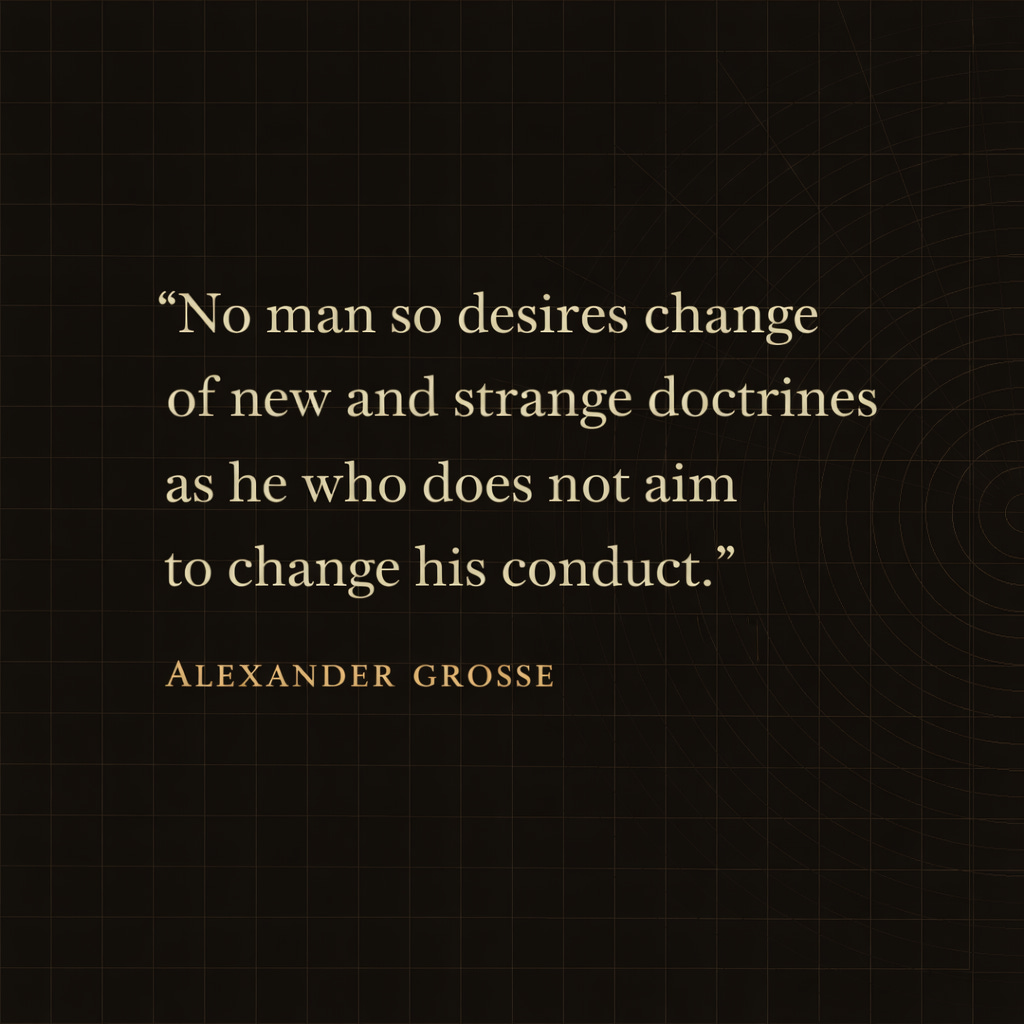
“No man so desires change of new and strange doctrines as he who does not aim to change his conduct.” (loc. 494)
That is a pastoral diagnosis worth reflecting on, maybe read that sentence again, I think it is worth meditating on. The man hungry for novelty in doctrine is usually the man unwilling to be changed by the doctrine he already has. New frameworks feel like progress, yet they are often in reality avoidance.
He goes further. The appetite for alternatives to Christ reflects a failure to taste Him:
“They have not learned the wisdom of Christ to be guided by Him; the authority of Christ to subject themselves to Him; the beauties of Christ to admire Him; the love of Christ to delight themselves in Him… Christ is to them a ‘hidden manna’ (Rev. 2:17) whom they taste not.” (loc. 498)
This is the root, this is the error. Not intellectual error, though error follows the twisted mind. The soul that has not tasted Christ’s sweetness will keep reaching for substitutes. Bernard put it this way, and Grosse quotes him approvingly: “As we begin to relish sweetness in Christ, so the world begins to be bitter to us.” (loc. 869) The problem is not that the world offers too much. It is that we have tasted too little of Christ!
What Human Doctrines Actually Do
Grosse’s critique of “human observations and philosophical principles” is methodical. He lists twelve ways they fail.
They do not reveal sin.
They do not humble the soul.
They do not nourish.
They do not pacify the conscience.
They deceive.
They allure to sin.
They impoverish the soul.
They bring it into bondage.
They adulterate sound doctrine.
They detract from Christ’s dignity.
They deny His authority.
They deny His wisdom. (loc. 516-535)
That is not a list about medieval scholasticism or pagan philosophy only. It describes any system of thought that claims to do for the soul what only Christ can do!
“Of all other doctrines, we may say as Job did of his friends, ‘Ye are all physicians of no value’ (Job 13:4). They neither point out nor cure the disease of the soul.” (loc. 424)
This is where I think Grosse speaks directly to our moment. There is no shortage of therapeutic and ideological frameworks today that promise to identify what is wrong with you and fix it. They are sophisticated, credentialed, and sometimes well-meaning. And they cannot open the door of the heart. They leave a man, as Grosse puts it, “ignorant of God and himself.” (loc. 516) No doctrine shows us God except the one that comes from God.
The Absurdity of Looking Elsewhere
Grosse reaches for images to make the point unavoidable.
“It is absurd to run to a rotten cistern for water, having beside us a full and living fountain, or to go to a glowworm for light, having the sun to guide us.” (loc. 339)
The man who leaves Christ and looks to human invention for wisdom about his soul is not making a minor error in judgment. He is behaving like a man who walks past a spring to dig in dry ground.
The behavior is not tragic in a sophisticated way. It is simply the way of the fool.
And yet Grosse notes it is the most common failure: “An evil very common and popular to the souls of men.” (loc. 657) Our Savior said as much: “Ye will not come to me, that ye might have life” (John 5:40).
The refusal is not primarily intellectual. It is volitional, a matter of the will. We will not come.
The Sufficiency Is Real
The positive argument in Grosse is not a slogan, a trite saying. It is a result of exegesis. He anchors everything in Colossians 2:9-10:
“In him dwelleth all the fulness of the Godhead bodily. And ye are complete in Him, which is the head of all principality and power.”
Complete. The Greek word (pepleroomenoi) is passive and perfect. You have been filled and you remain filled. The fullness that fills you is not borrowed or derived. It is the fullness of God Himself, dwelling bodily in Christ, and by union with Him, made yours.
Grosse draws out the implication:
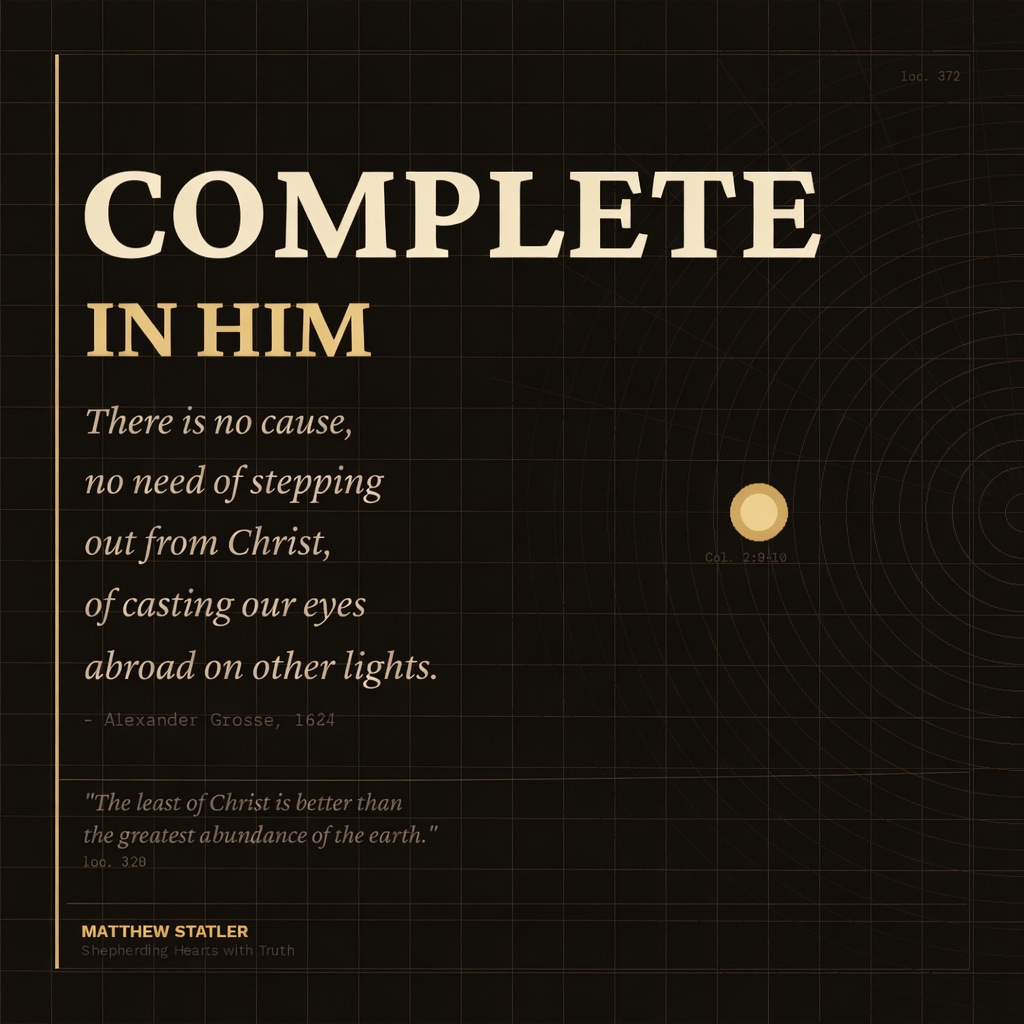
“There is no cause, no need of stepping out from Christ, of casting our eyes abroad on other lights, of joining other things to Christ, or of mixing and mingling other things with Christ.” (loc. 372)
You are not looking for something you lack. You are failing to use what you have. The need is not acquisition. It is use.
What It Looks Like to Actually Live This
Grosse closes with a summons it functions less as an argument and more as a vision:
“Leave all and come to Him, that He may fill you with His grace first and with His glory last.” (loc. 767)
He is not calling for a one-time decision. He is describing the shape of the whole Christian life. The soul that has learned to live by Christ finds in Him what he used to seek everywhere else: wisdom, justification, mercy, comfort, satisfaction.
“The least of Christ is better than the greatest abundance of the earth.” (loc. 320)
The man who believes it will stop shopping, the man who catches the vision will cast his eyes to no other water. He will come to Christ for what only Christ can give, use the ordinary means of grace with seriousness, and find that the restlessness settles. Not because he has found a better framework, but because he has stopped needing one.
Alexander Grosse, The Happiness of Enjoying and Making a True and Speedy Use of Christ (1647). Quotes lightly modernized for readability.